Call for Art:
We’re Looking for Art to Feature in these Newsletters
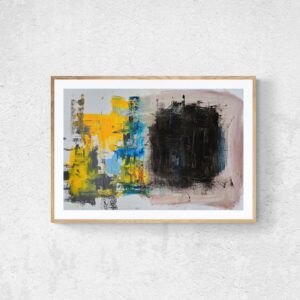
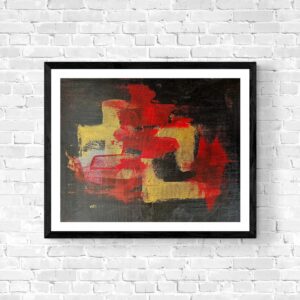
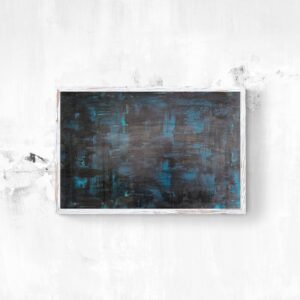
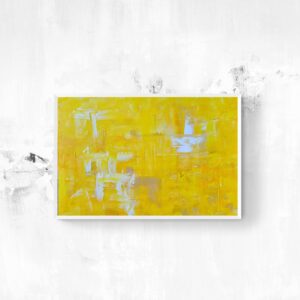
We do not use AI to generate images and we’re always looking for great art by real artists to feature in our newsletters! If you are an artist (or know of one), please leave a comment with a link to your art. Each piece we feature goes to more than 100,000 inboxes and is properly attributed with backlinks to the artist’s website.
We have another post today by Eugene Terekhin, the man and the mind behind the publication Philosophy of Language.
Eugene is a regular contributing writer to The BoldBrush Letter.
How a Tree Taught Me to See
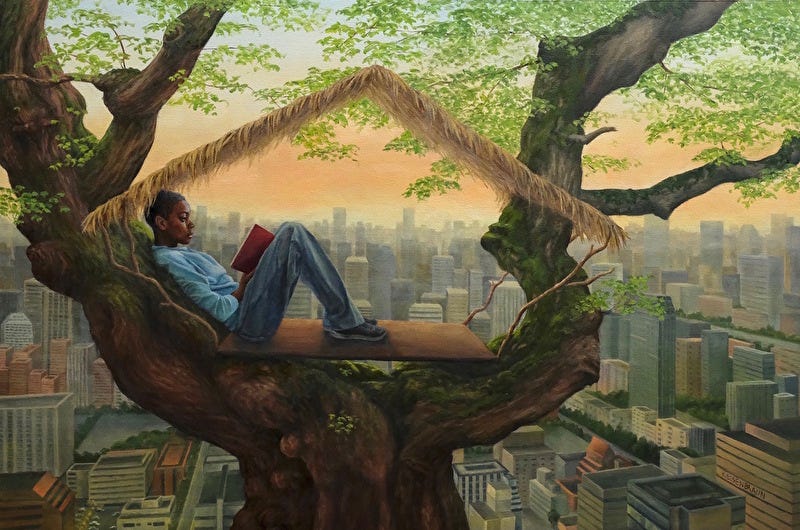
In his seminal work I and Thou, Buber describes an experience where he encounters a tree not merely as an object (an “It”) but as a “Thou” – a presence he can relate to. He writes:
I contemplate a tree.
I can look at it as a picture…
I can feel it as a movement…
I can assign it to a species and observe it as an instance…
Throughout all of this the tree remains my object and has its place and its time span, its kind and condition.
But it can also come about, if I have both will and grace, that in considering the tree I am drawn into relation, and the tree ceases to be an It.— Martin Buber
We can look at a tree as if it were a picture, an object, something entirely unrelated to me. Or we can see it as more than an object – a living presence turned toward me and granting me the grace of a relationship.
I can still remember speaking to a tree as a child. It grew right outside my window. In the USSR, we were taught that universe was nothing but matter – and that matter is all that matters. However, something in me resisted. I would look at that maple and ask: “Do you think it’s going to rain?” or: “Will I get a new hockey stick for New Year’s”?
If it waved a branch, it meant “Yes.” If it didn’t, it meant “No.” Believe it or not, the maple was right at least 50% of the time. 😊 It was much later that I found that Martin Buber called this encounter “dialogue.” You can’t have a dialogue with an “It.” To have a dialogue, you must have a Thou.
If all we see in a tree is a picture – an image before our eyes – we don’t yet see the tree. We only see an image of it. No one who sketches a face thinks that this image is all there is. We all know that an image points to something beyond itself. A drawn face points to a real face. There’s always a reality behind an image.
If I say: “This picture of a tree is all there is,” I have turned an image into the ultimate reality. That’s the very definition of idolatry – deifying images. We live in the world of deified images. We live among idols – pictures of an absent reality. And yet, every once in a while, we have a grace to see more in a tree – or a human being – than meets the eye.
Buber calls this moment “grace.” To see reality is a gift from above.
The Thou encounters me by grace – it cannot be found by seeking. — Martin buber
The Thou is a revelation – a disclosure of Being. It’s like that moment in The Lord of the Rings when Merry and Pippin, wandering in Fangorn Forest, are suddenly lifted high and turn to find themselves staring into Treebeard’s huge, ancient eyes. The tree is looking, walking, and speaking.
A grace moment is when we are granted the eyes to see the world looking at us. In that instant, we discover the world as an icon – a living symbol. As Pavel Florensky, the Russian Orthodox priest and scholar, emphasized, it is the icon that looks at me, not I who look at the icon.
One of the guiding principles of iconography is reverse perspective – where all the lines converge in the viewer. The icon reveals to us that all the eyes of the universe are turned toward us. We are being looked at. The icon is the ultimate antidote against idols. It discloses the DNA of all creation – Relationship.
As Martin Buber put it, “In the beginning is the relation.” And: “All real living is meeting.” That must have been what I felt as a child, watching that maple sway in the wind – revealing itself as an icon and quietly inviting me into a relationship.
PS – Please help us get more exposure for the artists featured in this newsletter by clicking the “Like” icon or by leaving a comment. The more engagement we get, the more widely these images get shown. Help us support human artists and push back against the encroachment of AI!
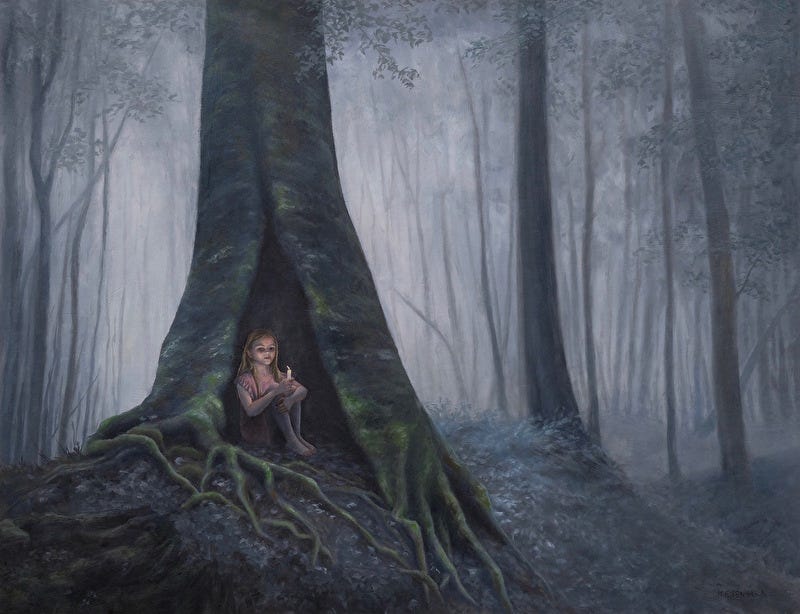
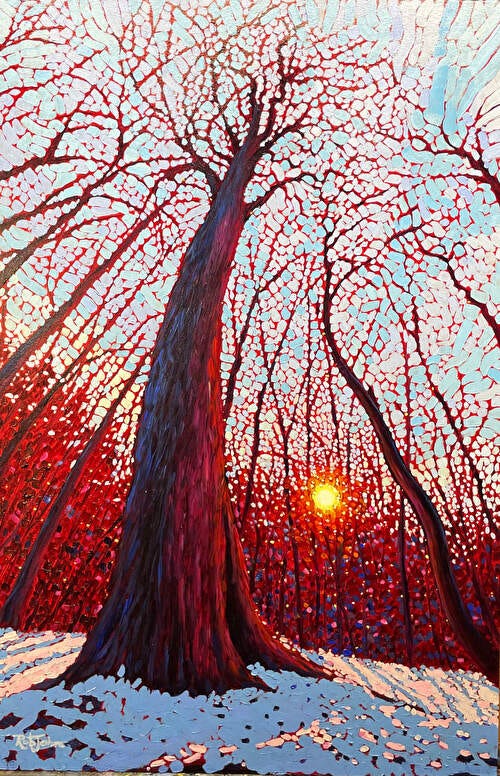
FASO Loves Todd A. Williams’ oil paintings!
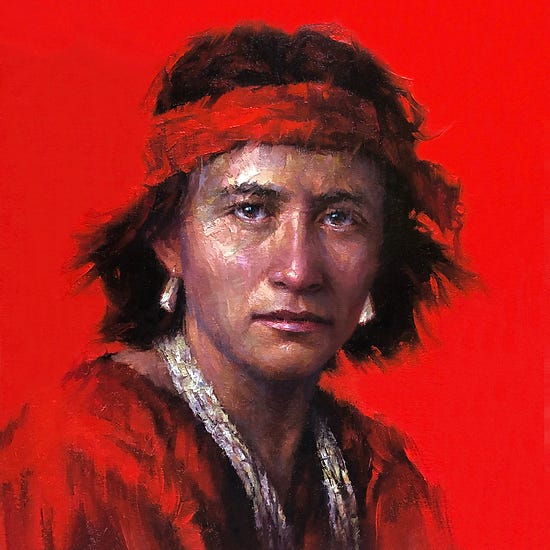
See More of Todd A. Williams’ art by clicking here.
Wouldn’t You Love to work with a website hosting company that actually promotes their artists?
As you can see, at FASO, we actually do, and,
we are the only website host we know of that does.
Click the button below to start working
with an art website host that actually cares about art.
No AI Zone: Everything written in this post (and all our posts) is written 100% by flesh and blood humans
We do not use AI images with our writing. We prefer to feature and provide more exposure for human artists. If you know of a great piece of art we should consider, please leave a comment with a link to it. All featured images are properly attributed with backlinks to the artist’s website.